Reading this piece of journalism from 1905 at face value gives a grim view of vice in Milwaukee. Looking back at the view the writer paints from today’s more permissive perspective makes his picture seem misrepresented. Some of the things “seen” at the saloon are obvious urban legends and symbols instead of real eye-witness accounts. It’s hard to believe anyone would seriously think children’s marbles would lead to a life of gambling or that coin-operated player pianos playing rag-time music were emblematic of the road to sin. The article continues to use almost every logical fallacy that exists in its argument to sway the reader.
Vice and crime had been a well-known part of downtown and the near south side for many decades prior to this. Areas of the fifth ward were written of as a “tenderloin district” in late 19th century news articles where even police would never go alone.
There are a few interesting things in the article that may need some explanation. The mention of the “arc light” refers to a short period after gas street lights were being replaced by electric lights. One experimental light source that was being tried around the country was the “arc light”. Milwaukee installed a few of these downtown and they were hung above the middle of an intersection by wires. The light was very bright, almost as strong as daylight. The down side was that the carbon filaments would have to be changed often. Once incandescent lights became more available and bright enough, they swiftly replaced arc lights.
The streets mentioned at the beginning of the article may be unfamiliar to some. Johnson Street is now East Highland Avenue and Oneida Street is now East Wells Street. Today’s popular Water Street bar area is a direct descendent of the old red light district.
The quote,”Milwaukeeans reluctantly accept the word of their worthy executive when he assures them that the district must be preserved to decrease crime,” refers to Mayor David Rose, whom some may have heard was soft on the enforcement of the red light district. Interestingly, his ideas had some merit. The push for national Prohibition many years later and strong enforcement of those laws through the 1920s ended up creating a huge organized crime network which caused many problems in Milwaukee and around the country.
The article below is from the Milwaukee Free Press of February 19, 1905.
It lies almost in the shadow of the city hall, within whose stately home walls sit men sworn to enforce the laws of the municipality, and others whose duty it is to dispense justice in accordance with the laws.
It is repugnant to many, this “Red Light” district, so called, with this whispered but unwritten stories of vice and of numberless men and women ruined through its influence. But the objection is of a passive sort. Milwaukeeans reluctantly accept the word of their worthy executive when he assures them that the district must be preserved to decrease crime.
For whatever reason it is allowed to exist, or encouraged to remain, the fact is indisputable that it is there. Its limits are not absolutely fixed, but in a general way it extends along the east river shore from Oneida street to Knapp street, on intersecting streets to East Water street, and in some instances Market street, and on East Water street from the city hall to Johnson street.
The outsides of its temples are there for the inspection of all. Children on their way to school look wonderingly at them. Mothers hurry past, amazed at the city’s shame. School boys, old enough to realize the conditions to some extent, smile knowingly at each other in secret. Half frightened at the thought, they plan to know more of the secrets within the walls when they are older.
As the first false step of the future gambler is often the simple game of marbles “for keeps,” so the comparatively innocent saloons on the outskirts of this district offer the first attraction to the curious youth of the city.
A cold winter night. The wind sweeps down the almost empty street. The arc lights send their bluish radiance to the pavement below, and it glints along the ice bordered car tracks. The creak and crackle of the trodden snow on the sidewalk beneath the feet of the lonely patrolman on his beat, tells as well as a thermometer of the bitter, biting cold.
At frequent intervals along the street, shafts of yellow light shoot out from half-curtained windows. From the bar rooms beyond the protecting glass, come sounds of music and maudlin laughter. Occasionally is heard the noise of voices raised in anger and then a loud commanding ejaculation that causes the arguments to cease.
It is in these places that men not unknown to the social and business world stand elbow to elbow with gamblers and others who have spent weary weeks in jail and prison; here, also beardless boys assume an air of wisdom to discuss the latest news of track and ring – with red eyed, bloated beings sunk deep in the dragging mire of dissipation.
Across the room from the polished bar and artistically adorned mirror with its border of sparkling glasses, back of the tables at which men talk in low voices or nod it drowsily over a half filled glass, is a piano with slot machine attachment. A nickel dropped within the opening will cause it to disgorge a stream of lively “rag time.”
White coated bartenders hurry from one group to another with the dripping trays. They smile appreciatively as a man announces that he has won the dice game and his companion must buy the drinks. Occasionally, in answer to the buzzing call from the annunciator near the huge refrigerator, one hurries behind through the swinging doors at the rear of the room.
Beyond them lies the leather seated stalls and wine rooms. They may be reached from the streets by the “Ladies’ Entrance.” Both sexes may gather here without causing comment. It is the primary evil that supplies victims for that inner section of the “Red Light” district where morality is forgotten and degradation and degeneracy in its worst sense, holds sway.
Within the confines of these wine rooms may be studied the story of the downfall of women and the degradation of men in every stage. The innocent and tempted girl, the reckless boy, the abandoned woman – all are there.
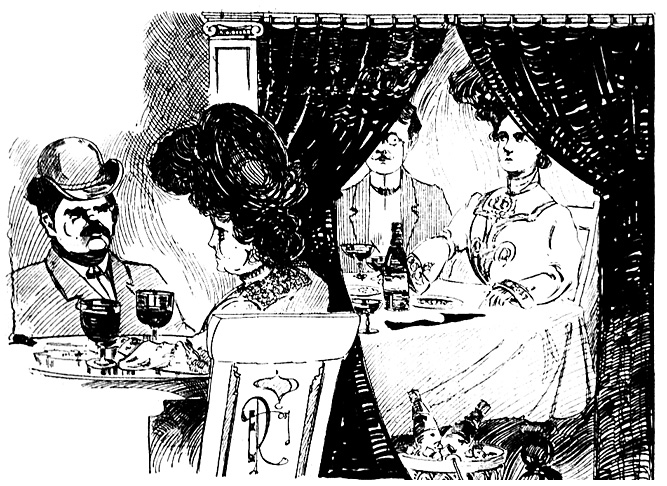
Merry voices are heard outside the street door. There is a momentary hush, and then it swings open to admit a party of four people. They are two modest appearing girls clinging to the arms of their escorts. The men are well dressed. Their companions might have been students or clerks.
Looking about, startled, they hesitate again. Then, with downcast eyes, they hasten into the protection of a curtained booth. In response to the waiter’s query, they laugh in an embarrassed manner, communicate with their eyes, and order beer.
“You had better try a cocktail,” says one of the men with a smile. “They will do you good after the cold weather outside. Bring us four Manhattans,” he concludes, turning to the man with the tray.
Even as they talk, there comes a sound of a maudlin feminine chuckle from the next stall. Within its confines a boy, anxious to prove himself a “good fellow” had taken a chance acquaintance and bought her drinks. Unfortunately for him, she was more accustomed to them than the purchaser. He now lay back in his chair, his head lolling against the wall behind him, and the labored but regular breathing showed him unconscious from the sleep of intoxication. As he sat there, his companion leaned across the table and reached in his pocket. Pulling out a handful of bills, constituting his month’s salary, she removed three or four and place them inside her waist. The remainder were returned.
The work done, she looks again at the unconscious figure and laughs. Then she spreads the curtains and steps out, leaving him to sleep until employees come to order him out. To the street she goes in search of another victim.
In a large room, more secluded than the little stalls, there sit a party of women. Their gaudy furs and wide-plumed hats are tossed aside and there are disclosed the painted faces, blackened eyebrows and bleached hair that so often marks the members of their trade.
“Send in some good fellows,” one remarks to the waiter, as she slips over a generous tip in addition to the price of the four drinks before them. “Pick out somebody that looks as if they have the money to burn and wanted to get an assistant fireman.”
The white coated man grins.
“Alright sis,” he remarks. “There’s three lovely ones out here. They are home from some boarding school and I guess they just got their next installment to carry them through the spring term from the way they act. If they are satisfactory, I will come in later and take a drink on you.”
Suiting the action to his words, he soon returns with the group from the bar room. They enter the wine room. The door is closed, and another incident of the evening has begun to be enacted.
The sound of carriage wheels is heard on the pavement. They come to a stop. Two figures emerge and hurry to the dark doorway. One is a typical sport. His small shifty eyes are set in a face not unhandsome; his evening clothes are immaculate; his conversation is that of one accustomed to talking. His companion is a woman who is known as a prominent figure in a middle-class social set. Her husband is not the man at her side.
Muffled in furs, her face is barely discernible. As the couple enters the building and proceeds to the half-concealed table, an intimate friend might have passed her and not recognized her. She is one of those females of the Jekyl and Hyde class, who may be seen in every city. Fortunately for society, they are not frequent in this.
Through the early hours of the morning they sat talking in low whispers. Occasionally the arrival of another drink disturbs the talk, but it is resumed again. This subject is not to be learned by outsiders. Then, as quietly as they came, they hurry out of the door, resume their places in the carriage and are driven rapidly away.
Many and varied are the saloons in this “Red Light” district.
Here may be seen the Bohemian “bier stube,” with its female bartender and quaint musicians dispensing harmony from instruments still more quaint. Yonder is a negro hang-out, where the casual visitor is greeted something after this fashion: “Beer? Yes sir. Ever shoot craps? Or play poker? There’s a good, square game in the back room there. Better take a chance. Nothing risked, nothing won. Shoot a dime, shoot a quarter, take a stack of chips – any way to double your money. Be game. Take a chance. No? Well come again, sir.”
Interspersed with these resorts whose character forbids even a cursory descriptions are the immoral saloons of still lower class class with their upper rooms in which men are lured by gaudy, painted creatures who barter their very souls for the gold that is later spent in riotous celebration. Here are women who perhaps, are engaged in respectable occupations for a portion of the day, and who spend their nights in occupations that lead them to forget their church, friends, family – all.
This blot on Milwaukee’s map is not large in its area. But in every paving stone, on every sidewalk flagging, on every doorstep is written the history of bodies weakened and destroyed, of minds undermined and ruined, or souls degenerated and lost.
Necessary? Aye, it may be. But to those who advocate the theory, let the question be put of the manner in which they would accept the news of the presence there of sister, brother, son, or wife.
Unavoidable? Perhaps. But why should the cost be paid in the souls and bodies and lives of others’ families instead of the families of those who argue that mankind’s weaknesses should be accepted “reasonably,” instead of being overcome and prevented?
The night wanes. The hands of the great clock in the lofty tower have swung around the dial and the five booming strokes of the melodious bell mark the approach of sunrise.
Down the snow-covered walks men stagger, singly or in groups. Cab drivers query passers-by in the hope of a final “fare.” Two women walk with uncertain gait toward their homes. Their escorts have deserted them. Physical weariness, aching heads, mental disgust – these alone are left to remind them of the night of “pleasure.”
In the bar rooms, the cash is counted carefully and the rolls of bills and glittering heaps of silver show the tribute of Milwaukee to the great god of Bacchus – in his temples in the “Red Light” district.